High School
Millsap's Miraculous Season Is a Testament to Jacob Johnson's Legacy
A month after losing head coach Jacob Johnson, his son Braun is the state's leading rusher on the Millsap Bulldogs' first district championship team since 1999.
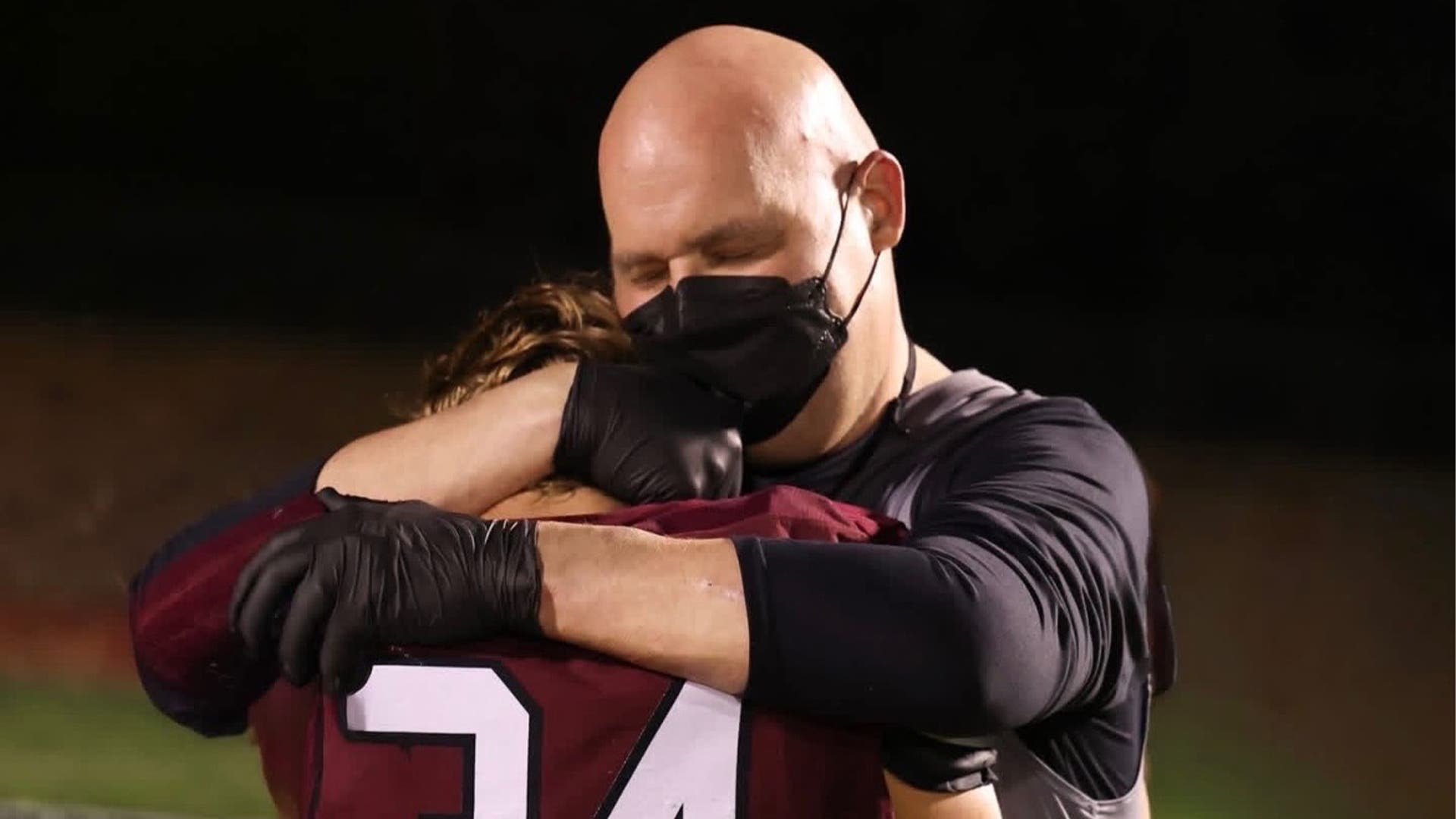
Cassie Johnson and her daughter, Payton, clutched the Gold Football between them, shuffling toward an expectant huddle of young men chomping at the bit to hoist Millsap High School’s first district championship trophy since 1999.
As they drew closer, Cassie rifled through her mind for something inspiring to say. She tried thinking of what her husband would’ve said. Jacob Johnson had so many traits that made him an amazing head coach. But perhaps the most important was that he always had the right words to get a group to laugh, love, cry, or run through a brick wall on his command.
Through 22 years of marriage, she’d strived every day to be more like Jacob. But, as she knows better than anyone after losing him to leukemia in late October, no one is. So, when the moment came, all she could muster was a point to the sky before raising the trophy above her head with both hands.
“It was almost like, ‘Am I really handing this golden football over to these boys, and it’s not Jake doing it?’” Cassie said. “It was awful and wonderful all at the same time.”
Her son, Braun, was the first kid to grab the trophy. Braun had rushed for 208 yards and two touchdowns that night, bringing his season total to 2,565 yards, the most of any player in the state of Texas. But the Gold Football was the only award he or his father had cared about. Now he was holding it for both of them.
“When my dad was fighting for his life, what he thought about was you,” Braun told the team.
Tears and sweat streamed down his face, muddying the eye black spread across his cheeks and garbling his words. The emotion threatened to overcome him. But like the defenders clinging to his back as he dragged them across the goal line, he fought off the sobs. He had something to say. And his father had something to say through him.
“I know right now he’s up there,” Braun said. “You’ve been through hell and back, gentlemen. This is pay day, ain’t it? And we’ve got a lot more to come. I love all of you, man. And so does he.”
Jacob and Braun don’t necessarily look alike. Dad was larger than life, too big in stature and personality to be of this world, officially listed at 6-foot-2 but seemingly becoming taller as he led a team and, in his prime, a 325-pound offensive lineman without an ounce of fat on him. Braun himself looks like he’s cut from granite, but he stands at 5-foot-10 and 205 pounds. Dad was bald with a long beard. Braun is clean-shaven with a blond mullet. But when Braun speaks, he does so with the same conviction and cadence his dad had. When you close your eyes, you’re almost convinced it’s Jacob talking. And when you open them and see his son standing before the team like this, there’s no mistaking that, in a way, it is.
Two weeks have passed. The Bulldogs have since won their second playoff game since 1999. But time has not dulled the shine of that moment. There are a million words in the English language. Braun has filtered through them all, and yet none adequately describe that night.
“That feeling of everyone coming together and praising the Lord for the victory, having me and my family’s back, I physically do not have the vocabulary to put that into words,” Braun said.
Maybe someday, time will allow us to look back on the best season in Millsap history and sum up what happened and why in a manicured sentence. Right now, it’s all too raw. Words can’t encapsulate the 12 years Jacob Johnson spent pouring into the young men of Millsap. Words can’t describe the loss and hurt of his passing at just 45 years old after a courageous battle with chronic myelogenous leukemia. They can’t express how proud this community is of this team’s perseverance in winning the district title, and of his son’s perseverance in becoming the state’s leading rusher. And they certainly can’t capture the pain that Jake isn’t here to celebrate it all.
So the best thing to do is sit back and watch Jacob Johnson’s life’s work unfold before your eyes on a Friday night in Millsap. The words can come later, because the story is still being written.
“All of us are heartbroken together,” Cassie said. “We just all want to come together and do our best to keep his legacy going. This football program is part of his legacy. That fieldhouse was his ministry.”
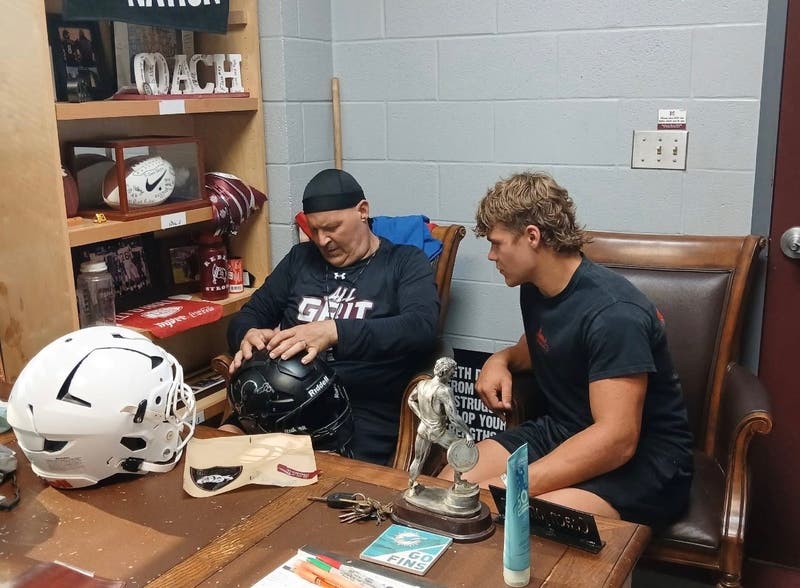
Jacob Johnson met Cassie Bull at Southwestern Baptist University in Missouri. Cassie’s brother played football with Jacob, and because she was in cosmetology school, she used to cut the entire team’s hair. Their relationship started in the barber’s chair. Then it grew to hanging out in groups. Before long, they found any excuse to be together.
They married when Jacob was 23 and Cassie was 21. In the weeks after his death, Cassie calls flipping through the family photo albums a surreal experience. Her eyes drift to her and Jacob, marveling at how much they grew together, just as much as her kids have matured. Most people look longingly at old photos, remembering a time when their hair was fuller and their skin was tighter and their love was fiercer. Cassie considers herself one of the blessed few who have the opposite experience, where every day spent with Jake was better than the last. They were more in love than ever on the day he died.
“Jake is my favorite person to talk about,” Cassie said. “People are like, ‘I don’t know how you can talk about him.’ I’m like, ‘Why would I not? He was incredible.’”
There were so many things she loved about him: his love for the Lord, his massive personality and, yes, his big muscles. But what Cassie admired most was the kind of father he was.
“He made me a better mom, because I watched how awesome of a dad he was,” Cassie said. “I would always tell him, ‘You’re so much better of a dad than I am a mom.’”
Jacob was the most intentional human being she ever met. He unearthed a life lesson hidden in everything the family did. One summer, when the kids were in elementary school and every other family was on a beach vacation, Jacob created the Johnson Week of Champions. They rose at 4:00 a.m. every morning and raced each other in obstacle courses or pushed each other in group workouts. Then, as the rising sun peeked over the trees, they’d sit in a circle for Bible Time.
“I don’t want us to be like everyone else,” Jacob told them.
For some kids – and adults – that sounds like torture. But Payton and Braun relished that time with their father. Braun’s favorite TV show was Dual Survival. So, every spring break, Jacob and Braun would go to the family’s hunting lease. There was a perfectly good cabin with working appliances and plumbing. But father and son brought no food or water, planning to eat only what they killed and build shelter out of tree branches and moss. At night, by a crackling fire, Jacob would sit watch with a loaded gun, eyeing the rattlesnake dens and listening for coyotes and bobcats while Braun slept soundly, protected.
The survival trips stopped as Jacob’s cancer progressed. But over the last year, Jacob and Braun metaphorically traded places, with Braun keeping watch when Jacob needed rest. Braun hasn’t gone out with his friends in a year. He and his dad had the same nightly routine. They’d trek to the next-door neighbor’s garage gym as Braun prepared for his junior season and Jacob built his strength back after a blood transplant. Then they’d come home and drink their protein shakes while they watched a movie in the living room. Before bed, they’d read a Proverb together.
When Jacob was admitted back into the hospital on October 12, he and Braun thought they were just pausing that routine.
After living with chronic myelogenous leukemia for years, which is treatable with a chemo pill, Jacob developed acute leukemia this spring, which required a blood transplant. In the months after the procedure, Jacob’s preliminary results showed no signs of leukemia. But he’d developed a mutation, which meant another transplant, which meant he needed to stay in the hospital for three weeks – in the middle of football season – on chemotherapy treatment to prepare.
Jacob planned to coach from the hospital bed. He could watch the game on the stadium camera’s stream and call his offensive coordinator between series. Before the game, Johnson FaceTimed one of the coaches and told him to give the phone to Braun. He had a surprise for him.
For years, Braun has worn his eye-black in the same style as Ultimate Warrior from WWE, completely covering the bottom of his forehead and extending a thin streak down to his jawline so that all a defender sees before he runs them over are his wild eyes and snarled teeth. Ultimate Warrior didn’t walk into the ring, he sprinted from the locker room and flung himself onto the cage; overcome by the Warrior spirit. Braun plays, and Jacob coaches, the same way.
When Braun took the phone, he saw his dad on the other end with the Ultimate Warrior paint on, a needle in his arm, and a nurse probably cowering somewhere behind the screen as Jacob Johnson screamed loud enough for Braun to hear him from the hospital room an hour and a half away.
“Man, I’ve never been so fired up in my life,” Braun said. “He was yelling through that phone, fired up, spit flying. I’ve never been so hyped.”
Braun rushed for 420 yards and five touchdowns on 30 carries. It was the last game his father ever saw him play.
In the end, leukemia didn’t kill Jacob Johnson, at least not directly. Chemotherapy destroys your body’s white blood cells, the primary defense against infections, zapping your immune system. In this weakened state, bacteria that a normal person can fend off instead burrow into the body and cause sepsis. One day after Braun’s performance against Rio Vista, one day after Jacob had lathered on the face paint and coached an entire game from the hospital, he went into septic shock.
The doctors described Jacob’s condition as a car crash. The moment he went unconscious that Saturday was the moment all the damage happened. So even though his vital signs worsened over the next few days as his kidneys, liver, and heart all failed, Jacob Johnson didn’t feel any more pain for the first time in years. He was already gone.
Late Thursday night, Cassie called Payton and Braun and told them to drive to the hospital. Jacob had been on the maximum amount of medical intervention for a week, and nothing was working. The doctors said tonight was the night.
“When it’s your time to go, and the Lord is calling you home, there is nothing you can do about it,” Cassie said. “Because we tried everything.”
Jacob Johnson passed away in the early morning hours of October 23, 2026, surrounded by the people he cared about most: his wife and children, his parents who’d made the 14-hour drive, and his brother who’d flown in from North Carolina. His passing was sudden, unexpected, and far too soon. But he ended it with closure, his heart a gas tank on empty.
“Jake loved people,” Cassie said. “He loved well, and he loved very big. There is not a soul out there that he left wondering how he felt about them.”
And there was no question whether Braun would play in that night’s football game against Eastland, despite leaving the hospital at 4:00 a.m. Cassie could hear Jacob’s voice in her head, bewildered: “What do you mean Braun didn’t play?” Jacob and Braun had worked toward this season since Braun was in kindergarten. Braun used to crank out 100 push-ups and 100 sit-ups in his room before bed every night. In the summer, he’d spray-paint yard markers on the family’s lawn and run football drills by himself. His commitment was so singular that even Jacob would tell him to slow down.
That night, after thirty minutes of sleep, fresh off the loss of his father, football coach, and best friend, Braun Johnson ran for 326 yards and six touchdowns, averaging 23.3 yards per carry, as the Millsap Bulldogs crushed Eastland 63-0.
“We played Eastland the same day he died,” Braun said. “I think I was at the hospital until 4:00 in the morning. Then, we went and played Eastland. And we laid the hammer down.”
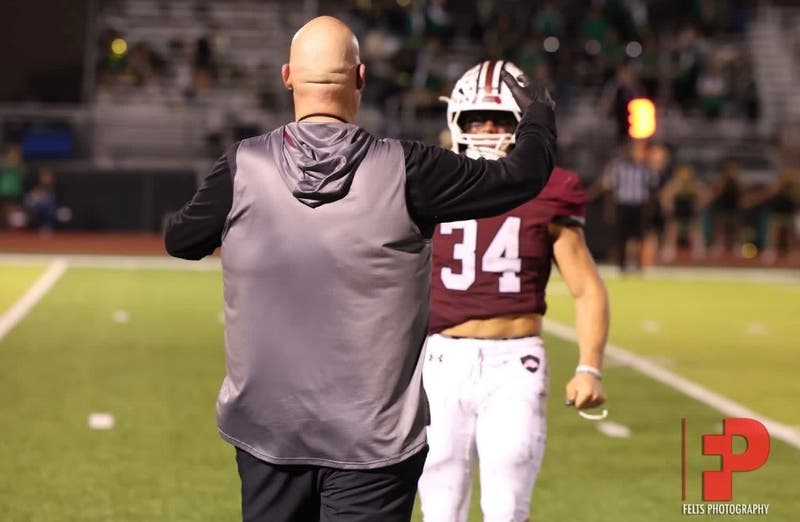
Part of what makes Braun’s season so remarkable – leading the state of Texas in rushing yards and bringing the Millsap Bulldogs to the second round of the playoffs for just the second time since 1999 – is that he didn’t just lose his father a month ago: he lost a football coach and his best friend, too.
He laughs remembering how his dad was always his biggest cheerleader and harshest critic. He still remembers the butt chewing he got after practice one day when he got smoked behind the line of scrimmage and complained about the play call sacrificing him.
“One thing that he absolutely hated – one action that anyone could do – was throw their palms up,” Braun said. “If you threw your palms up, that was basically a slap in the face to him. That’s one line no one ever crossed. Ever.”
He’s asked why that was his father’s cardinal rule.
“You know, man, I’m not sure,” Braun said. “Sadly, I never got the chance to ask him. I was planning on doing that soon, actually.”
Over a decade of working together, Millsap interim head coach Will Bass saw how important body language was to Jacob, even more than winning and losing.
“If you throw up your hands like something is out of your control, then it is out of your control,” Bass said. “You’re giving up control of yourself and your reactions to the outside circumstances. When you do that, you’re not going to be able to perform at your best.”
Cancer gave Jacob every opportunity to throw his palms up in the air. Why does a good man who’s lived his life by the book and taken care of his body long after playing college football get a terminal illness? It all seems so unfair. Jacob himself grappled with the meaning of his illness.
“I wish I could sit here and say that through all of that I’ve never shed a tear, I’ve never had an anxious moment, I’ve never been afraid or frustrated,” Jacob said on a video he posted to his X account on July 28. “But unfortunately, that’s not the truth. Matter of fact, I still battle the fear and the anxiety and frustration.”
One of the hardest parts of cancer, for both Jacob and his family, was watching his strong, mountain of a body wither away from chemotherapy, his muscle mass evaporating by the day. Once, when Jacob walked in from the back porch, Braun and Payton both cried at the sight of him, ghostly white and physically weak.
“We thought, ‘That wasn’t my dad,’” Braun said. “But my dad was stronger than he ever was because of his mind and mental toughness. He couldn’t go beat up cancer, but by God he could fight it in his head.”
In those trying times, Jacob often read about Jesus in the Garden of Gethsemane the night before he was to be crucified. Jesus prayed for God to take this cup of suffering from him, so anguished that he began sweating drops of blood. But Jesus says that, no matter how much he wants his fate changed, God’s will must be done, and an angel of the Lord appears to give him strength. Jacob knew Jesus knew exactly how he felt. And, harkening back to Isaiah 50:7, he set his face like flint and charged into battle.
“Oftentimes, the suffering builds our faith,” Jacob said. “God allows that. Because faith that’s not tested is not faith at all.”
Since his passing, Cassie has flipped through Jacob’s Bible every day.
“I was going to look to see what he’s been into lately – seeing what he’s been highlighting and reading and what’s marked,” Cassie said. “It’s the whole dad gum thing!”
But there’s a passage Cassie keeps coming back to in Genesis 32. In it, the biblical Jacob is set to face his brother, Esau, 20 years after stealing Esau’s birthright as the firstborn son. Jacob hears that Esau has an army of 400 men. Certain of Esau’s plan to kill him and fearing for his life, Jacob wrestles with God for an entire night. The Lord touches Jacob and dislocates his hip, but Jacob keeps fighting. At daybreak, God changes Jacob’s name to Israel because he overcame the struggle.
In the corner of the margin, Jacob Johnson wrote that cancer was his version of a dislocated hip, and this was what he was wrestling with God over. But he ends the note with a message: ‘Praise God!’
“In the last three years, his faith got so much stronger,” Cassie said. “When you’re faced with something like this – faced with your mortality is the only way I can think of describing it – you can choose to run, or you can choose to lean into it. He leaned in.”
He never threw his palms in the air.
Dave Campbell’s Texas Football first wrote a story about Jacob’s cancer battle during the 2024 season. He’d kept in touch since then, texting every now and again when he enjoyed another story about someone else in the state overcoming their own struggles.
On October 16, the night Jacob coached from the hospital bed, we published a video featuring Braun’s spectacular season. The next morning, Jacob reached out about how thankful his family was. We exchanged a couple of texts back and forth, laughing about his Ultimate Warrior paint and how crazy the nurses must’ve thought he was. The idea for this story was formed then. He was supposed to be part of it. The article pitch was about Jacob coaching from the hospital during the best season in Millsap history, not about Millsap’s season in the wake of his death. We asked if he’d be ok with it.
“Absolutely brother!” Jacob texted. “Any chance to speak of the goodness of God!”
Jacob sent that message on Saturday, October 17 at 1:18 p.m., mere hours before septic shock set in. Jacob Johnson held fast in his faith until the very end, and now he’s dancing in Heaven with his Lord and Savior. So don’t question for a minute whether he won this fight.
“Having cancer is obviously a physical battle,” Bass said. “It takes a toll on your body. But it’s also a huge mental battle. The way that Jake battled this whole thing was basically him putting his money where his mouth was, as far as the lessons he taught these boys and this program over the 12 years he was here working with them.”
And with his example in mind, the entire Millsap community has charged forward. It’s not just the players experiencing historic success on the field, but their families who have stepped in to help his children just as much as Jacob helped theirs. Jacob and Cassie didn’t grow up in Texas. They’d never heard of this town of 370 people until Jacob became the head coach here. Frankly, they didn’t know why God called them there. Until now.
“The Lord kept us with this town, and this community, and these people, for such a time as this,” Cassie said.
Like the Johnson family 12 years ago, Braun knows there will be plenty of people who read this story that have never heard of Millsap. Some will stumble across this article having never heard of his father. But Jacob never cared much about whether people knew about him. He wanted them to know about God. And it honestly gives Braun a brain cramp thinking about how many more people will know more about God because of his father, as the generation of boys he coached grow up and create families of their own.
The last 12 years of Jacob’s life may have been confined to a town of 370 people, but the ripple effects will be felt across the country. Millsap’s playoff run is only the first ripple.
“I’m gonna be honest with you man – I knew he was important to the community, but I didn't know it was to this level,” Braun said. “It’s mind-boggling how one man, through the power of Christ, can do what he has done.”