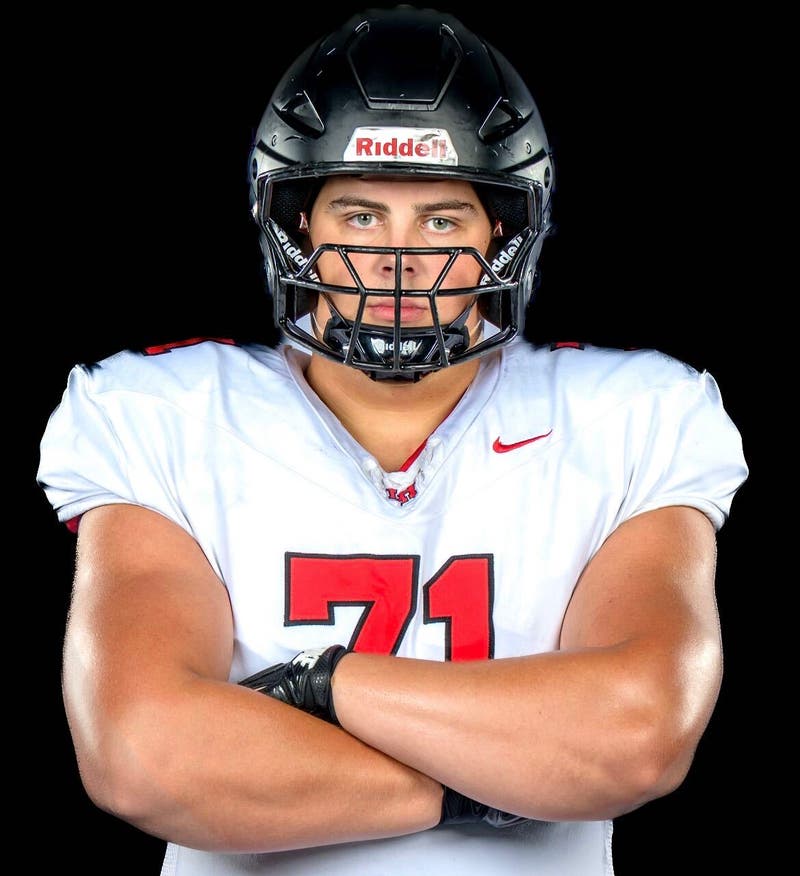
High School
The Captain: Lake Highlands' team leader hasn't played a down
Lake Highlands Wildcats offensive lineman Mason Busch suffered season-ending injuries in the first game of back-to-back years. His playing career is over, but his football story isn't.
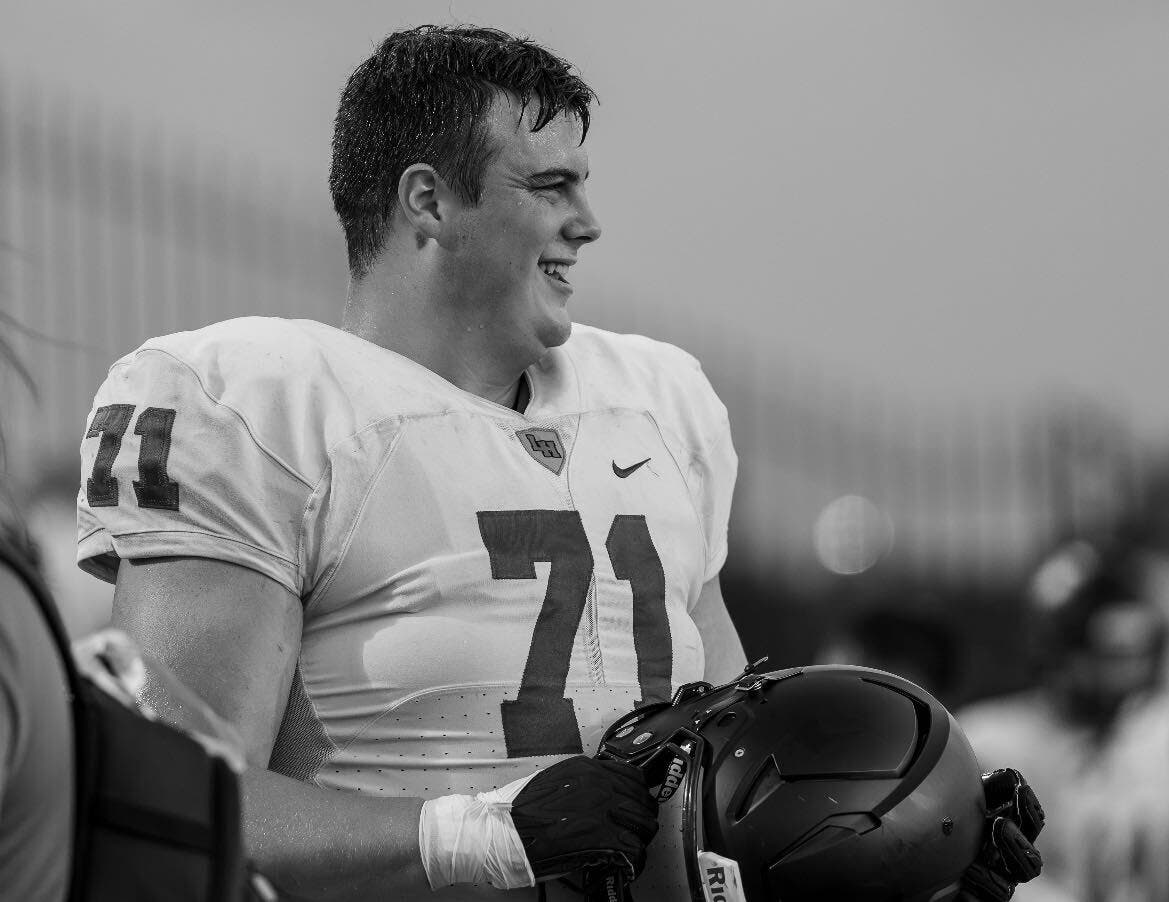
Alaina Busch never actually saw the final play of her son’s football career. Frankly, she’d thought the game was over. Maybe it was wishful thinking, because the clock was nearing midnight after a two-hour weather delay to Lake Highlands’ season opener against Forney.
So with five minutes left in the fourth quarter, Alaina climbed to the top of the bleachers. As the Lake Highlands team mom, she had to take down all the hand-painted posters at the top of the stadium. Given how late it was, she wanted to get out of there as soon as the game ended. But when she turned around, head poking out above the mound of white canvas balled in her arms, she saw the offense was back on the field. All the players were kneeling on the turf. And her son, Mason, was crumpled before them.
Alaina felt like she was moving in slow motion as she descended the bleachers, walking toward her husband and daughter clustered among the Lake Highlands faithful. The stadium felt silent, save for her daughter’s muffled cry.
That night, Lake Highlands’ first game of the 2025 season, was supposed to be a cathartic celebration for left tackle Mason Busch’s return to the field. The year before, as a sophomore, he’d torn his ACL on the final play of Lake Highlands’ season opener against Forney. Mason rehabbed for a year to suit up again, inspiring teammates and earning one of Lake Highlands’ two junior team captain spots. But now the same injury happened again. In the season opener again. On the last play of the game again. Against Forney again.
But before the trainers even reached him, Mason knew this injury was much worse. The year before, the only reason Mason knew he was injured was that he’d heard his ACL pop, like someone snapping a rubber band on their arm. He hadn’t felt any pain. He’d even asked the team doctor if he could go back in. This time, he’d heard the same sound, except his leg was on fire. He’d soon find out it was because he’d torn every ligament in his knee except for his PCL. But what hurt the most was what that pain signaled. It was all too fitting that the second injury happened at 12:00 a.m., because it felt like the clock had struck midnight on Mason’s Cinderella story.
“I was just lying on the turf,” Mason said. “I was crying, but not for the reason like ‘Oh, I’m in pain,’” Mason said. “It was more so the thought of, ‘I’m done.’”
Seeing your child injured on the football field is every parent’s worst nightmare. But watching your child suffer a season-ending injury, then claw his way back into the starting lineup, only for that same injury to happen again, is worse than a nightmare. At least in a nightmare, you seize control when you wake up and almost chuckle at the absurd scenario your brain concocted. This story is just absurd, except Mason’s parents would wake up every day knowing their son had done everything right to get back onto the field, had lived out every principle they’d instilled in him, and still had his heart broken. It’s a helplessness that’s almost hard to describe.
“For it to happen again the way it did – the same team, almost the same time of the game, almost a year to the day – it rocked us,” Mason’s father, Brian, said. “We were shocked. You just feel for him, because he really did put a ton of work in to get back.”
As the trainers helped his boy off the field, Brian immediately reflected on all the rehab Mason had endured, learning how to walk and run again. He wondered, agonized, really, about Mason having to go through that grueling physical therapy without the carrot of football to motivate him.
But as Mason left the field for the last time, he wasn’t thinking about the finality of his football career. He was thinking about his parents having to take care of him again, helping him around the house, fetching him things he should be able to grab himself. Mason hated being a burden. Frankly, he carried the real burden. Yes, the physical rehab was part of it. But the heavier weight he bore was the devastated look on his parents’ faces, heartbroken that their son couldn’t do what he loved anymore.
“The injury itself isn’t the problem; it’s how it impacts everyone around you,” Mason said. “That’s the killer.”
Maybe Mason was right to worry about his loved ones more than himself, because every adult interviewed for this story says they wouldn’t have handled the injury as well as he did.
One year later, Mason still captains Lake Highlands’ 2026 football team, even though he’ll never play another down. He attends every film session and practice, helping the Wildcats prepare for the biggest game of the year against undefeated Coppell. But along the way, he’s an example to his teammates, and even his coaches, of what it takes to win something far more important than a football game.
“You’ve got your head in your hands, and you’re like, ‘How are we going to get through this?’” Lake Highlands head coach Cory Campbell said. “We kind of watched Mason. He kind of showed us the way.”
In that quote, Coach Campbell is talking about the despair everyone felt after Mason tore his knee up a second time. But he could be speaking about any time life forces you to put your head in your hands. It’ll happen to everyone on this Lake Highlands team at some point. Mason hopes they think of him when it does.
“I don’t want people to feel sorry for me,” Mason said. “I want people to battle through adversity.”
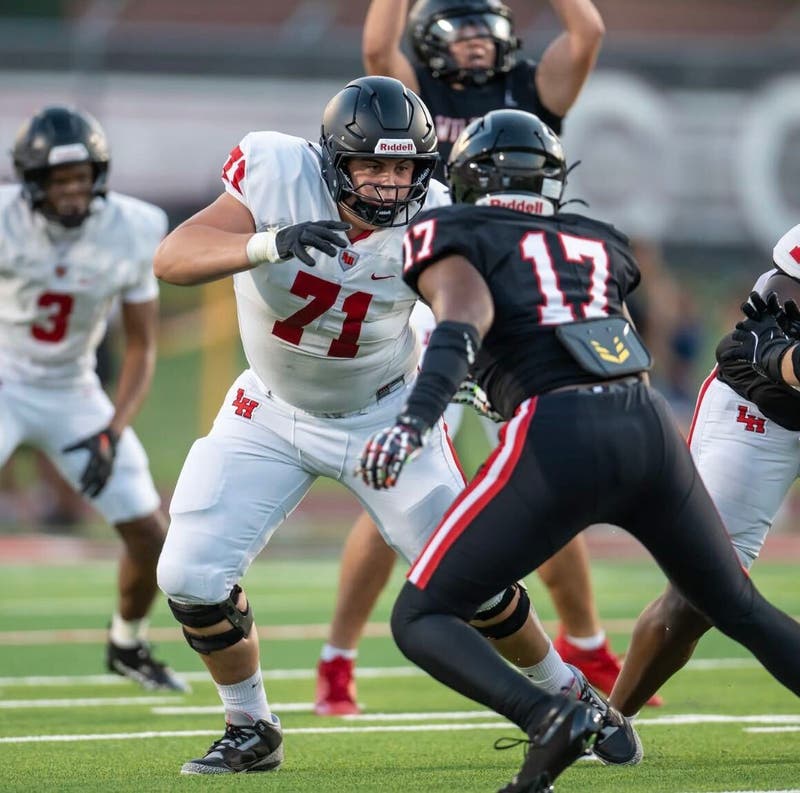
Before he was a college football recruit, Mason Busch was a blue-chip little league prospect in Lake Highlands.
Mason didn’t play tackle football until the fourth grade. His father, Brian, was a big-time athlete who competed in swimming, basketball, and tennis. At first, Mason wanted to follow in his father’s footsteps and become a college basketball player. But all the area dads noticed that he stood head and shoulders above the other kids, and they finally convinced him to join the football team.
“My earliest football memory of Mason is in fourth grade tackle football, the first year he played,” his mother, Alaina, said. “He was getting fitted for his pads and helmet, and as soon as he put it on, it looked like that’s what he was meant to do.”
In Mason’s first game, he lined up at nose guard on the defensive line, bowled over the center, and recorded a sack. The parents on the sidelines erupted in applause. From that moment, he was hooked. He craved the cheers, and he couldn’t wait to hear them at Lake Highlands High School.
Lake Highlands is a unique community in Northeast Dallas. It has a Dallas address, but the school zone is just under 13 square miles, giving the neighborhood a small-town feel. It’s the kind of area where only one school logo is plastered on the convenience store windows, and alumni move back to raise their kids there.
The Busches are one of those many families. Mason’s mother, Alaina, graduated from Lake Highlands in 1999.
“She loved it so much that she wanted to come back,” Mason said. “She was a Highlandette and did the drill team. She knew in high school that she wanted to come back to raise both my sister and me.”
Mason dreamed of playing football for his mother’s school and bringing it back to the glory days she experienced. Lake Highlands made the state semifinals in three of the four years his mother was in school. By the time Mason started on the varsity as a sophomore, the Wildcats were a proud program that had made the playoffs every year since 2008. But Lake Highlands had never made it past the third round.
After Mason tore his ACL the first time, that quest to take Lake Highlands past the third round and fulfill a family legacy got him out of bed each morning during rehab.
“For anyone who’s been through an ACL injury, it is a long, long journey,” Alaina said. “You just have to learn to celebrate the small milestones, like, ‘I can walk now. I can jump now. Or I can run now.’ Little things like that. Or you just get really bogged down by all of it.”
But from the moment his knee buckled the second time, Mason knew that dream was over, at least in the version he’d envisioned. Yet something in the back of his mind kept screaming that he wasn’t done yet, that he still had something to prove. That internal voice overpowered his mom, dad, and all the people who told him his career was over, until finally his surgeon sat him down and said he needed to swallow his pride and stop playing football, or else run the risk of never walking again.
Mason says he blacked out when the doctor told him that horrible news. He didn’t say a word to his mom as she drove him home, his football career now in the rearview mirror. Only the top .00001 percent of football players decide when their career is over, retiring from the NFL. For everyone else, they’re told when football is done with them, whether that's because no franchise drafts them or no college recruits them. Of course, Mason knew that his football career would eventually end. It had just happened far sooner than he ever wanted, and not on his own terms.
For young athletes, the hardest part of a career-ending injury isn’t just not playing anymore, but losing part of your identity. There are so many reasons to share Mason’s story, but above all, Lake Highlands football coach Cory Campbell wants kids across the state to realize they aren’t defined by the sport they play.
“The value of a young man or young lady can’t be just what they do between the white lines,” Campbell said. “I’ve really taken to heart his story, and how much perseverance he went through. I use that in my own life every day.”
Campbell’s daughter is a freshman who made Lake Highlands’ varsity volleyball team. Soon, his son will play football for him. So he treated Mason as he’d want a coach to treat his own kids if they suffered a career-ending injury.
“Even when he knew I couldn’t play anymore, he’d still check on me every single day and ask about me, how it’s going and what the timeline is,” Mason said. “He wanted to know what he could do to help me, not just to play football, but to come back and be a normal person.”
The sad reality is that many of the kids in Mason’s situation disappear from the football program. Sometimes it’s because the coaches stop paying attention to them when they can’t play. Other times, it’s because the kid doesn’t want to attend practices or film sessions without the reward of suiting up on a Friday night. But from the moment Mason’s playing career ended, both Coach Campbell and the Busch family were determined for Mason to still be part of the team.
“I’ve been doing this for almost 30 years, and his character and work ethic are second to none,” Coach Campbell said.
So Mason kept showing up, driving the younger kids to and from practice and even doing conditioning workouts in the summer (and winning the reps, he might add). But attending practice was bittersweet for him. He needed the community and camaraderie, but he couldn’t stand being halfway part of something. That’s why he dreaded the upcoming vote by Lake Highlands players for team captains. He figured he’d lose his captain’s designation, a reminder that he wasn’t as important as he once was.
“I’m thinking in the back of my head, ‘I’m not playing; somebody else should probably take that spot to show leadership on the field,’” Mason said. “But people still voted for me. I guess they wanted me to be here, whether I was on the field or not.”
“That probably saved me a little bit. That started taking me up from rock bottom.”
At Monday’s practice, Mason still looks every part of the future college football lineman. He’s still a hulked-up 6-foot-4, 285-pound physical specimen. He says serving as captain of Lake Highlands’ country and western dance team keeps him in shape. Really, the only evidence of the trials he’s been through is the scar on his right knee. But every day he spends at football practice with his team, those scars, both physical and psychological, heal a little more.
“Injuries don’t define you,” Alaina said. “Adversity happens, but it’s about the way you handle it. Your attitude shapes you. I’d love for anyone who has to go through it to talk to him.”