College
'How Haven't You Won Here?': The Lamar Awakening
Lamar football was stuck in neutral for decades. Now, Pete Rossomando and Jeff O'Malley have the Cardinals climbing toward the top of the FCS with bigger goals ahead.
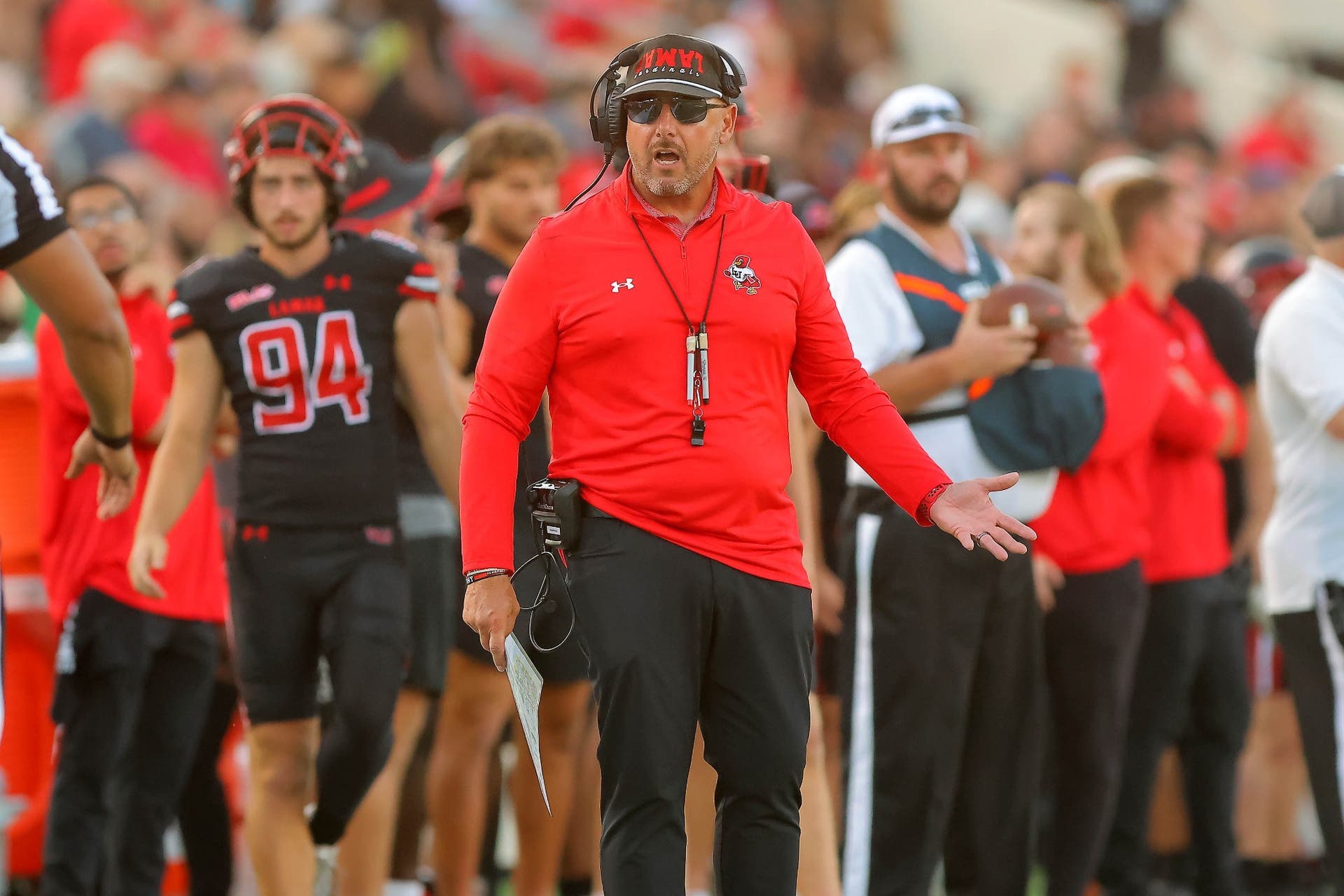
(Photo: Jeff Kellum)
Pete Rossomando’s first interview for the Lamar job was over the phone with athletic director Jeff O’Malley. His second interview was a Zoom call with O’Malley and Lamar University president Dr. Jaime Taylor. The third – and final – interview was in Houston at a hotel next to Bush Airport.
After the in-person interview in Houston, Rossomando rented a car and drove 100 miles east on I-10 to Beaumont to check out Lamar’s facilities for himself. He looked at the football building and then the stadium before calling O’Malley to ask a simple question, “How haven’t you won here?”
O’Malley wondered the same thing when he was hired in the summer of 2022 and first saw the facilities on campus. He spent the first month trying to figure out why the football team, and most of the other athletic programs, were stuck in a rut. The bones were good from a facility standpoint, but the mentality wasn’t a winning one. Too many people were working against each other.
The program was stuck in bumper-to-bumper traffic, starting and stopping for most of its history. The university’s football program began in 1923 when Lamar University was still South Park Junior College. The football program was discontinued in 1928 and returned in 1932. It was disbanded again in 1942 and didn’t return until after World War II.
The golden years for the Cardinals on the gridiron occurred from 1957-1967 when they claimed four Southland Conference titles and enjoyed 11 straight winning seasons under head coaches J.B. Higgins and then Vernon Glass. Lamar knocked off Middle Tennessee in the 1961 Tangerine Bowl – the last time the program won a playoff game.
Hard times returned when the football team was disbanded again in 1989 by a Board of Regents vote of 5-4. The idea was to divert money used for football into basketball and turn the Cardinals into a basketball power. But football was back again in 2010.
Rossomando was the head coach at New Haven, a Division II team in Connecticut, when Lamar announced it was bringing football back ahead of the 2010 season. He applied with the hopes of getting to Texas where football mattered more than it did in his native Northeastern part of the country.
His father-in-law has lived in Houston for over 20 years so he’d read the Chronicle when he was in town and was in awe of how much passion and pride the local high school communities took in their football teams.
“I wanted to go somewhere where football would be really important,” Rossomando said about his interest in coaching in Texas. “If you have high school football like that, naturally the colleges in the area should be good. Because you have a lot to pick from.”
Rossomando never heard back from Lamar. He led New Haven to three straight Northeast-10 Conference championships from 2010-2012, reaching the NCAA Division II quarterfinals in 2011. His next stop was Central Connecticut, where he led the Blue Devils to a Northeast Conference championship in 2017 and into the NCAA Division I playoffs.
He left his head coaching chair at the end of the 2018 season to join the Rutgers staff as the offensive line coach. He was an offensive lineman himself at Boston University, where he played for offensive coordinator Tony Sparano. It was Sparano who talked Rossomando into trying out the coaching profession once his playing days were over, offering him a GA position at New Haven in 1994.
It wasn’t something Rossomando had considered. He went to school to become a physical therapist, but an externship turned him off that career path. He was hesitant when Sparano pitched him on coaching, pointing out how long the hours were, but he didn’t have any other ideas so he figured he’d try it for a year or two.
“I never looked back,” Rossomando said. “I enjoyed being around the guys. I always felt like if you could affect someone’s life in a positive way like my coaches did for me, that would be a cool thing to do every day.”
Rossomando found his way to Charlotte by 2021 and was named the interim head coach for the 49ers at the end of the 2022 season following Will Healy’s firing. Charlotte was 1-7 to start the season, but finished 2-2 over its last four games with Rossomando in charge. He’s still the only head coach in Charlotte’s program to finish with a .500 or better record with more than three games coached.
O’Malley made the decision to fire Blane Morgan following a 1-11 record in 2022. He was 5-23 over three seasons the Cardinals were 52-91 since reforming the football program in 2010. His ideal candidate was someone with head coaching experience who had been at the FCS or Division II level and would appreciate the upside of Lamar’s facilities and location.
O’Malley called Mike Hill, who was the athletic director at Charlotte, and asked if there were any candidates that he liked but didn’t hire for the 49ers job. Hill gave O’Malley a few names. The next day, he called O’Malley back and gave him one more name – Rossomando.
“I looked at (Rossomando’s) background and it fit almost to a T what we were looking for,” O’Malley said. “The only heat I got was that he wasn’t from Texas, but a hall of fame coach told me not to eliminate a good football coach because he’s not from Texas. The coach we had to fire was from Texas. So, it worked out.”
O’Malley assured Rossomando that he didn’t need to hit the ground running. Three or four wins in the debut season of 2023 would be labeled a success. Rossomando wasn’t having any of it. His expectations were higher and his plan was to win right away.
“I had enough confidence in myself,” Rossomando said. “I had a strong feeling that with the resources we have and the staff I could hire that we could be competitive. And they weren’t competitive before, so I thought we could change that.”
The Cardinals had only enjoyed two winning seasons since 1980 and that was in 2014 and 2018. Rossomando led them to a 6-5 mark in 2023 and a 7-5 mark in 2024. The group won eight games last year, including a non-conference win at home over No. 4-ranked South Dakota, and reached the FCS playoffs for only the second time.
Lamar is 4-1 to start 2026 and is ranked in the top 10 of the FCS Top 25 for the first time in school history. The season began with a win over Abilene Christian – the team that knocked the Cardinals out of last season’s playoffs. The lone loss was to Louisiana, an FBS team. They’re 2-0 in Southland play heading into this weekend’s clash with UIW.
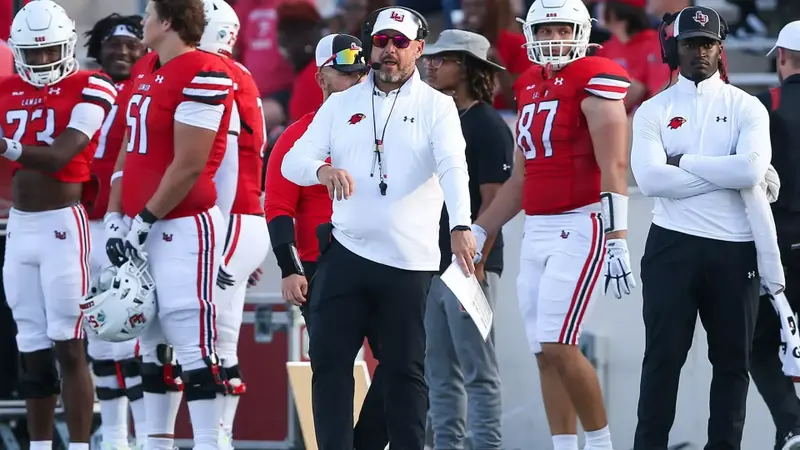
But don’t expect Rossomando to gloat. He’s not satisfied.
“I still don’t feel like we’re at a point where we’ve reached our potential,” he said. “I think we’re still climbing. We haven’t made it yet, so every day is a new opportunity to improve what we do and how we do it.”
O’Malley and Rossomando aren’t shy about their ultimate goals at Lamar – an FCS national championship. There is no secret sauce to the recent success. The program was asleep and needed the right people to build the correct alignment. That’s exactly what has happened in Beaumont with Dr. Taylor, O’Malley, and Rossomando working together to build something special. And lasting.
“It was getting people on board who were going to work together and go in the right direction,” O’Malley said. “Now we’re in a spot where it’s unlike anything I’ve been part of before because almost every campus leader wants us to be successful and is taking great pride in the success that the football team has had and the athletic department in general.
“That pride is picked up on campus and it has bled into the community, as well,” O’Malley continued. “There’s something special about where Lamar is right now and the people we have in place. I don’t take that for granted.”